
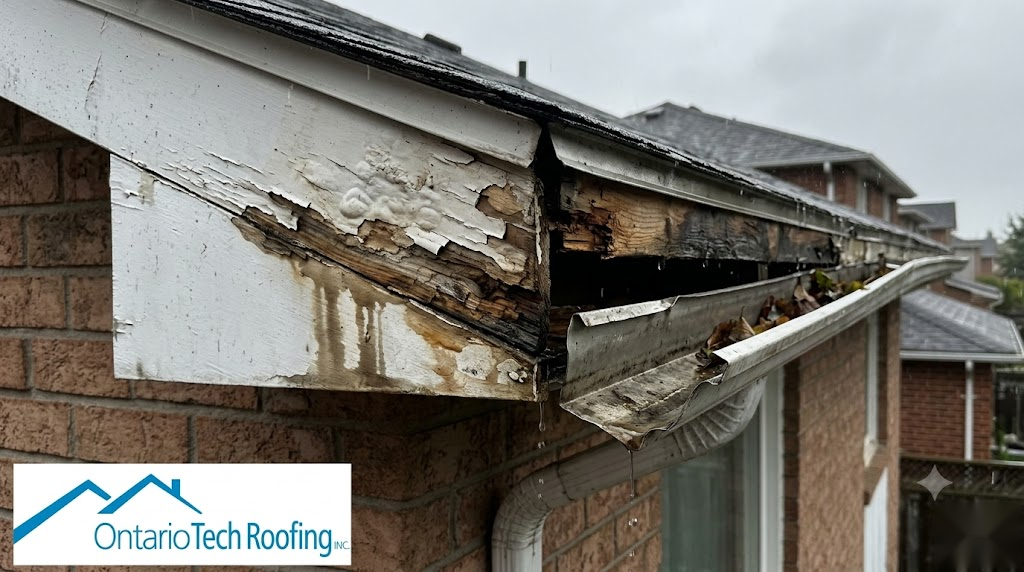
Nobody thinks about fascia boards. Ever. They sit tucked behind the eavestroughs, running the length of your roof edge, quietly holding things together. Until they don't. Then suddenly you're not dealing with a "minor" issue anymore.
If you're not familiar with the term, fascia is the wood trim right under your roofline, where your gutters are actually mounted. It looks decorative. It isn't. Your entire eavestrough system hangs off it, and it ties directly into the edge of your roof deck. So when it starts to fail, it rarely fails alone.
How It Actually Rots
It's never sudden. A gutter clogs up one fall and nobody clears it. A nail backs out. Some caulking cracks near a seam and nobody notices because, honestly, who's inspecting their fascia boards on a Tuesday? Water starts getting behind the board instead of running past it, and the wood starts soaking it up, rain after rain.
Then winter hits. Freeze-thaw cycles are brutal on wood that's already holding moisture, and by spring you might notice paint bubbling along the roofline, or a spot that feels a little too soft when you press on it. Sometimes there's dark streaking down the siding below. In the worse cases, you'll actually see the board pulling away from the roof, and the gutter sagging with it because it no longer has anything solid to hold onto.
A lot of this overlaps with what we've written about before in our eavestrough services — the two problems tend to show up together, not one after the other.
Why It Doesn't Stay "Minor"
This is the part people underestimate. Fascia isn't some standalone trim piece you can ignore and deal with later on its own timeline. It's structurally tied into your roof edge, so once it goes soft, it starts dragging other things down with it.
Your gutters lose their anchor point first, since they're hung on brackets or spikes driven straight into that board. Rotten wood won't hold a fastener, so the whole run starts to sag or pull away, and water ends up dumping right next to your foundation instead of away from it. Water also tends to migrate upward, under the drip edge and shingles, which is how you end up with rot creeping into the actual roof deck. And wet, soft wood is basically an open invitation for carpenter ants and squirrels looking for a way into the attic. Soffit damage usually isn't far behind either, since fascia and soffit are part of the same connected system.
What might've cost a couple hundred dollars to fix early can turn into a full eavestrough replacement, soffit and fascia rebuild, and roof deck repair if it sits long enough. We see this pattern often enough on service calls that our eavestrough cleaning visits always include checking the fascia behind the gutters — not just clearing leaves and calling it done.
What to Look For Before Winter
You don't need a ladder for this part. Walk around the outside of your house and look up at the roofline. Peeling or bubbling paint near the edge is usually the first clue. So is a gutter that looks slightly tilted or wavy instead of running straight. Water stains on the siding right below the roof edge are another one worth paying attention to, and so is any visible gap between the eavestrough and the board it's mounted to.
Catch any of that early and it's worth a closer look before the next freeze-thaw cycle makes it worse. Since you're already checking the roofline anyway, it doesn't hurt to glance over our notes on common causes of roof leaks, since a few of the same signs show up there too.
The Fix Is Smaller Than You'd Think
Caught early, replacing fascia is usually a contained repair — a section or two of board, not your whole roofline. Left alone, it takes your gutters, your soffits, and eventually your roof deck down with it.
Get Your Free Roof Estimate
Ready to protect your home? Ontario Tech Roofing has served homeowners across the GTA since 1998. Book your free estimate or call us at 905-616-4408.